Monday, May 3, 2010

An Unmarried Woman

An Unmarried Woman left me with the strangest feeling. Because I watched it in a room full of men, I somehow felt that the world of women had been intruded upon. I understand why the males didn't like this film. It is clearly a woman's film. I found the conversations between the women to be incredibly realistic, and I related to them, perhaps not in the exact words or content, but in the general mood for certain.

The element of this film I most enjoyed is the concept of a woman fully realizing who she is and what she wants by finally having room to just be. It reminded me of Coming Home in that sense. Both women had spent their lives being their husband's wives, and never had their own identity. When they were finally free of their husbands, their worlds expanded. They were both able to survive because they were able to reinvent themselves. Both of these women represented the attitude of the women of the 70s.

Dog Day Afternoon

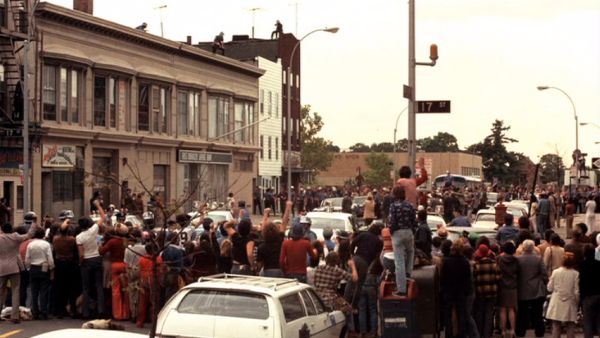
Of all of the films we screened in this class, this was strangely my least favorite. I explained to Francine that it just felt like a long film in which very little happened. I also felt that the story became slightly overdramatic at times. This is not to be blamed on the screenwriter, as it was based on a true story. I guess this story is proof that truth is, indeed, sometimes stranger than fiction.

There are elements of the film that were wonderful, however. The acting is amazing across the board. Not one character felt stiff or over directed. Everyone seemed natural in an unnatural situation. I also loved the role the crowd played in the story. I love the things crowds of people will get behind. It's never predictable, and it seldom seems to make sense out of the context of the time. Because this event took place after the Attica prison riot, the general attitude of young people was to not trust those in authority. I feel that this would have been a completely different story had it happened immediately following 9/11. Being such a fan of American history, I find it fascinating how the political atmosphere of the country affects everything else.

Perhaps I will try to watch this film again, at a different time in my life. Chances are I'll see it differently...

Saturday Night Fever

Although all of the movies we screened in this class are relevant to the 70s and to their respective genres, I felt that this film was the most relevant to me personally. I have spent the better part of my life in an Italian neighborhood, growing up with Italian boys that are now Italian men. Although we were on the Near West Side of Chicago, and not New York City, and we grew up in the 90s and not the 70s, there are definite parallels that can be drawn.

The boys I grew up with lived in a segregated little Italian pocket in a community filled with wonderful homemade food and regrettable old-school racist attitudes. The Italians over there have always protected their little pocket of land, known locally as "the Patch," and, until recently, managed to hold on. The boys found strength and safety with each other, and they also managed to exist as big fish in their little pond. Their family lives were not unlike those depicted in the movie, although some of them had it much worse.

Let me stress that the boys I grew up with did not gang rape women and did not dance. Most of these boys found themselves in monogamous relationships at young ages with the girls they ended up marrying. I don't know if it's the times that changed, or if my boys are truly a different breed than those boys in the film.

Saturday Night Fever gave me a new understanding of my friends. When I asked my boyfriend if he had ever seen this movie, he looked at me incredulously as if he were surprised that I even had to ask. Apparently this film is a big hit in that world, and I now understand why.

Tuesday, April 6, 2010

Taxi Driver

This is only the second time I've ever seen this film. The first time I saw it was when I was 18, and I didn't like it at the time. I think I was expecting something else the first time. It was good to see the movie again, years later, with an entirely different perspective on filmmaking and on life in general.

I felt more connected to the characters with this viewing. I understood where Travis Bickle was coming from, maybe just from being older and having lived more life. Scorcese did an incredible job bringing the audience into this spiral of disgust and insanity. I also feel that the score added so much to the film, and I definitely felt Hitchcock's influence all over the film, which I wouldn't have been able to appreciate at 18.

Interesting thing about this movie: As I mentioned, I had seen it once before and I basically remembered what happened in it, but only up to a point. In my memory, the last frame of the film was Harvey Keitel's dead body. I had completely forgotten that Travis had gotten away with his killing spree. I found this strange because it's a fairly significant aspect of the story. After the screening, I had a conversation with a classmate and he had the same memory (or lack thereof) that I did. He had also forgotten the way the film ultimately ends. I have to wonder if this was planned on Scorcese's part....were we not supposed to remember that?

Wednesday, March 17, 2010

JAWS


What can I say about Jaws? I'll start by admitting that the main reason I enrolled in the 70's class was because I couldn't pas up an opportunity to see Jaws in the screening room. This film makes the list of my favorite three films of all time. It is always a pleasure to watch, and I notice something new with every viewing.

First of all, I feel that this film is about homage. I feel that the story owes a lot to Hitchcock's The Birds. From the island setting, to the enemy being a force of nature, there are many parallels in these two films. The scene when Hooper goes into the water to examine the abandoned boat he and Brody come across brings to mind a similar scene in The Birds with Jessica Tandy. In Hitchcock's film, Jessica Tandy goes upstairs into the home of a local farmer and finds him dead, his eyes having been plucked out by the birds. When Hooper inspects the boat of a local fisherman, he finds the fisherman dead, one eye hanging from its socket. Jaws is also a film that inspires homage. There is a scene in Kevin Smith's Chasing Amy in which the characters are sitting in a booth much like the one in the Orca, comparing scars like Hooper and Quinn do in Jaws.

This film also reminds me of my personal history. I can remember many nights as a child watching Jaws with my mother. Every time we watched it, she would tell me the stories of she and her friends refusing to even get into a swimming pool after seeing the movie in the theaters. She would also tell me the differences between the movie and the original novel. I listened to her tell me about how Hooper had died in the book every time, although I had heard the stories before. For that reason, Jaws will always remind me of my mother.

Jaws is truly a classic film. It single-handedly changed 70s cinema. Every element of the film is amazing, from the acting, to the soundtrack, to the special effects. There is nothing superfluous about this movie, with every scene being absolutely necessary by moving the story along. I might just claim that Jaws is the perfect film.

Tuesday, March 9, 2010

The Conversation

This was a great film. It was good enough that I found myself on Friday night trying to explain the movie to my intoxicated, uninterested friends. It fully embodies the paranoia of technology that was such influence in 70s culture.

One can't help but relate this movie to the Watergate scandal. It wasn't just that Watergate made the American public, especially the younger generation, doubt their government. Watergate also pointed out just how far surveillance technology had come. If government officials could have their phone conversations recorded and be unaware, then what chance did the general public have? It seemed that if anyone could be recorded at anytime. This film certainly didn't put any paranoid fears to sleep.

I also enjoyed the film's theme of obsession. We watched this man's spiral into a debilitating fixation about this girl and her situation. Everything he did was for her. It was interesting character development and I found it fitting that the film ended with him sitting amidst the result of his obsessive personality.

Tuesday, March 2, 2010

The Parallax View

Some thoughts on the opening and ending sequences:
The opening parade scene in very communist looking. The colors are primary red and the marchers seem to be primarily Asian, both images that would symbolize Communism to American audiences. This scene immediately precedes the first assassination.

The closing parade scene is very patriotic. The tables are red, white, and blue. The marching band is dressed in blue and they are primarily white in ethnicity. These images, completed by the enormous pictures of the Presidents create a very American scene. This scene is followed by the second assassination.

This seems to tell the viewer that the conspiracy is everywhere...